
No products in the cart.
Uncategorized
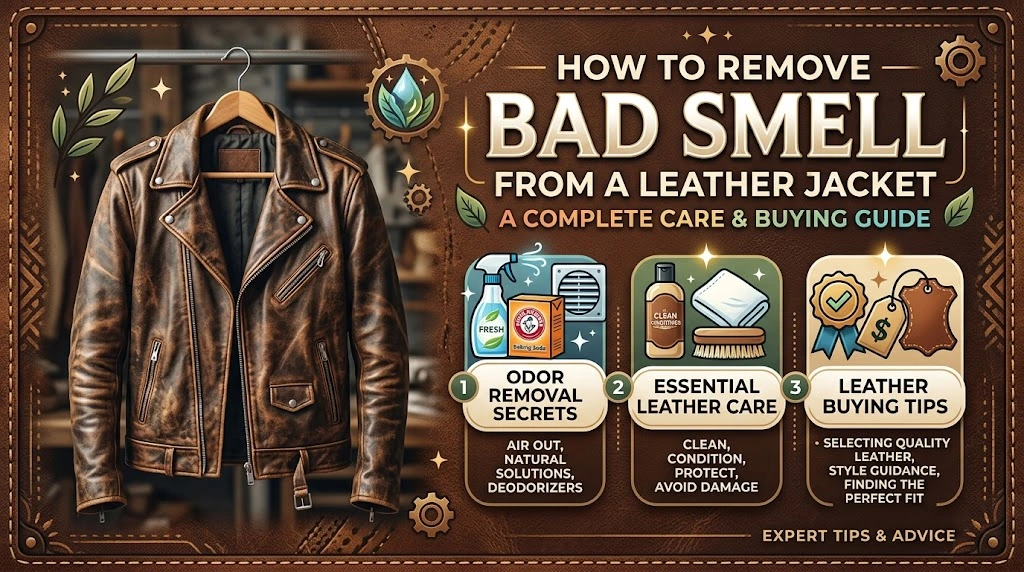
How to Remove Bad Smell from a Leather Jacket: A Complete Care & Buying Guide
29
Apr
Apr
That leather jacket hanging in your closet has a problem — and it’s not the style. It’s the smell. Whether it’s built-up sweat, cigarette smoke, mildew from bad storage, or that sharp chemical odor from a new jacket, bad smells can ruin an otherwise perfect piece.
The good news: most leather jacket smells can be fixed at home, without spending money on a dry cleaner, and without damaging the leather. This guide walks you through every cause, every solution, and how to choose a jacket that stays fresher for longer.
Table of Contents
- What’s Actually Causing the Smell?
- Know Your Leather Type Before You Treat It
- Method 1 — Fresh Air & Ventilation
- Method 2 — Baking Soda Absorption
- Method 3 — White Vinegar Solution
- Method 4 — Activated Charcoal
- Method 5 — Coffee Grounds Trick
- Method 6 — Leather-Safe Deodorizer Spray
- Method 7 — Steam Treatment
- Method 8 — Professional Cleaning
- How to Treat Specific Smells (Smell-by-Smell Guide)
- Mistakes That Make the Smell Worse
- How to Keep Your Jacket Smelling Fresh (Prevention)
- Buying Guide — Choose a Jacket That Stays Fresh Longer
- FAQs
What’s Actually Causing the Smell?
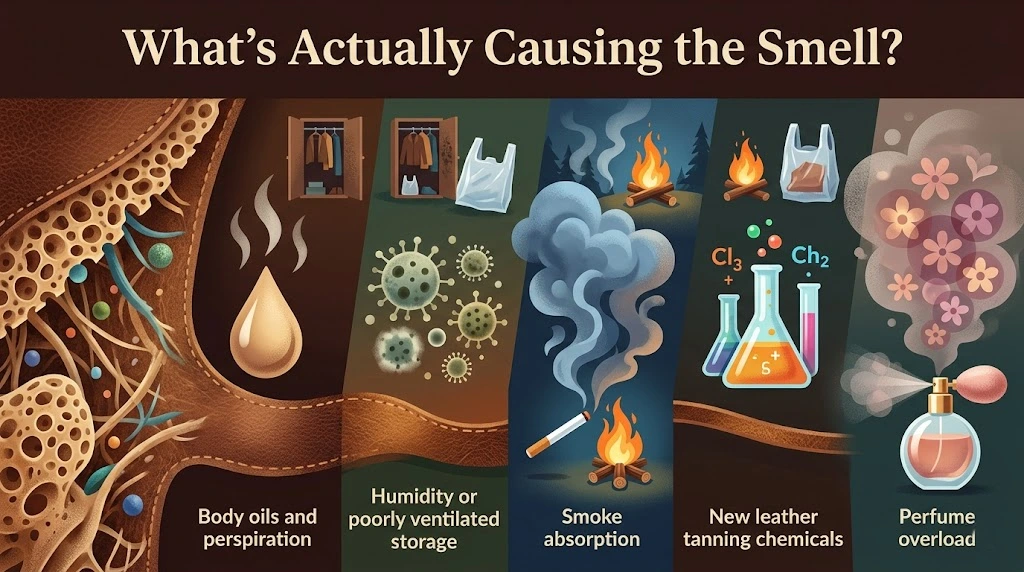
Leather is a porous, natural material. That’s what gives it its character — but it also means it absorbs everything around it. Before you treat the smell, identify what’s causing it so you pick the right method.
| Smell Type | Likely Cause |
|---|---|
| Sour / sweaty | Body oils and perspiration absorbed into lining |
| Musty / damp | Stored in a humid or poorly ventilated space |
| Smoky | Cigarette, bonfire, or kitchen smoke absorbed into fibers |
| Sharp / chemical | New jacket — tanning chemicals from manufacturing |
| Rotten / earthy | Mold or mildew growth (needs immediate treatment) |
| Stale / closed-up | Stored in plastic or an airtight space too long |
| Perfume overload | Fragrance residue layered over older smells |
Know Your Leather Type Before You Treat It
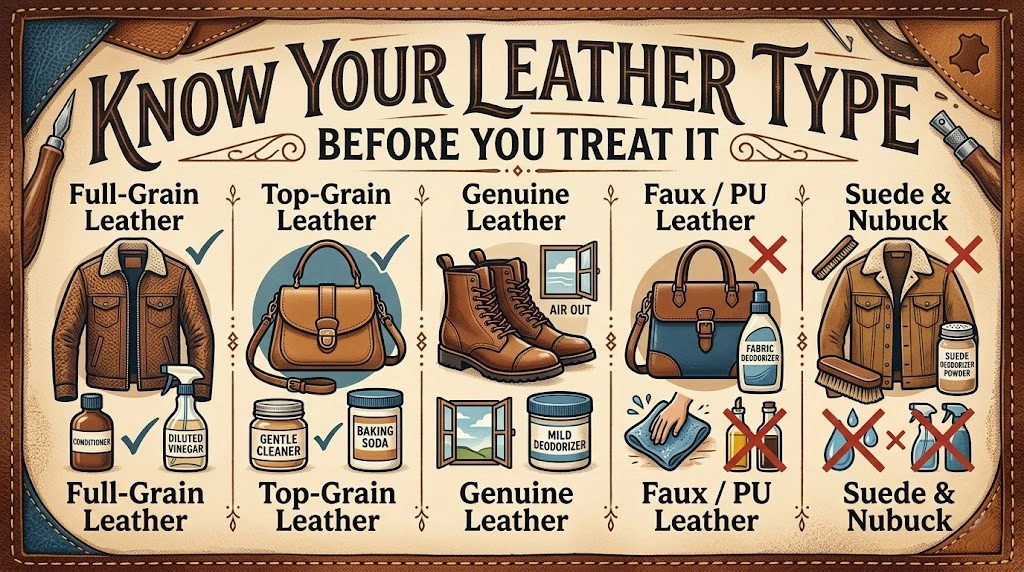
Different leather types react differently to cleaning methods. Using the wrong treatment can cause permanent damage.
Full-Grain Leather — Most durable, handles most methods well. Can tolerate diluted vinegar and conditioners.
Top-Grain Leather — Slightly more processed surface. Good with gentle cleaners and baking soda method.
Genuine Leather — Lower quality, more sensitive. Stick to air-out methods and mild deodorizers.
Faux / PU Leather — Not real leather. Avoid vinegar and oil-based conditioners. Use a damp cloth and fabric deodorizer only.
Suede & Nubuck — Most delicate. Never use liquid methods. Air out only, or use a suede-specific deodorizer powder.
Always patch-test any product on an inside seam or hidden area before applying it to the full jacket.
Method 1 — Fresh Air & Ventilation (Always Start Here)
Cost: Free | Risk: None | Best for: Light, everyday smells
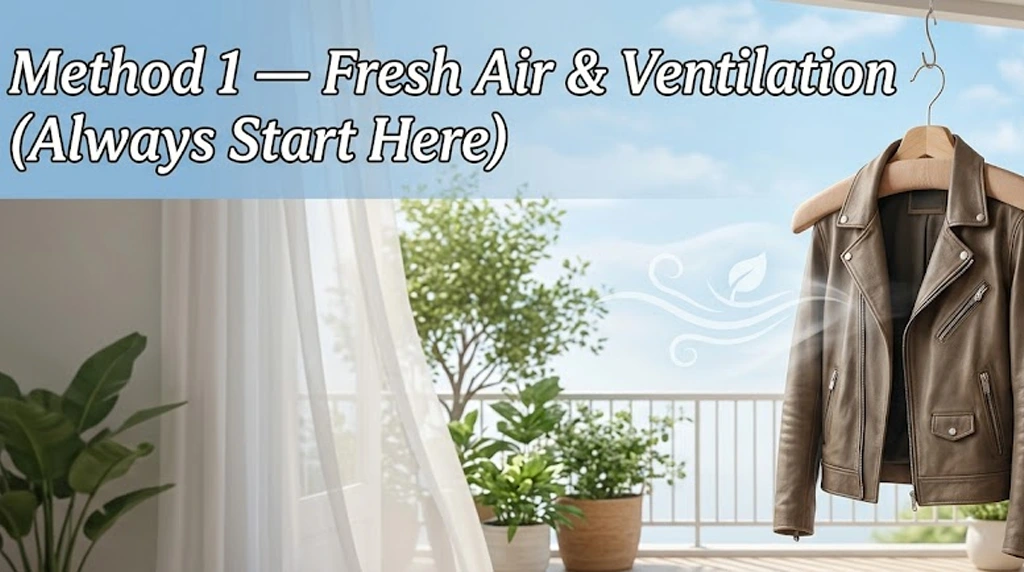
This is always your first step — and for mild smells, it’s often all you need.
How to do it:
- Hang the jacket on a wide, padded hanger
- Choose a spot with strong airflow — near an open window, on a balcony, or in a breezy room
- Avoid direct sunlight — UV rays dry out and crack leather
- Leave for 24 to 48 hours, turning it occasionally so all sides get air
- For stubborn smells, repeat for 2 to 3 days
Pro tip: A fan placed nearby speeds up the process significantly. Point it toward the jacket’s lining, not the exterior.
Method 2 — Baking Soda Absorption
Cost: Very low | Risk: Low (if done correctly) | Best for: Sweat, musty, and general odors
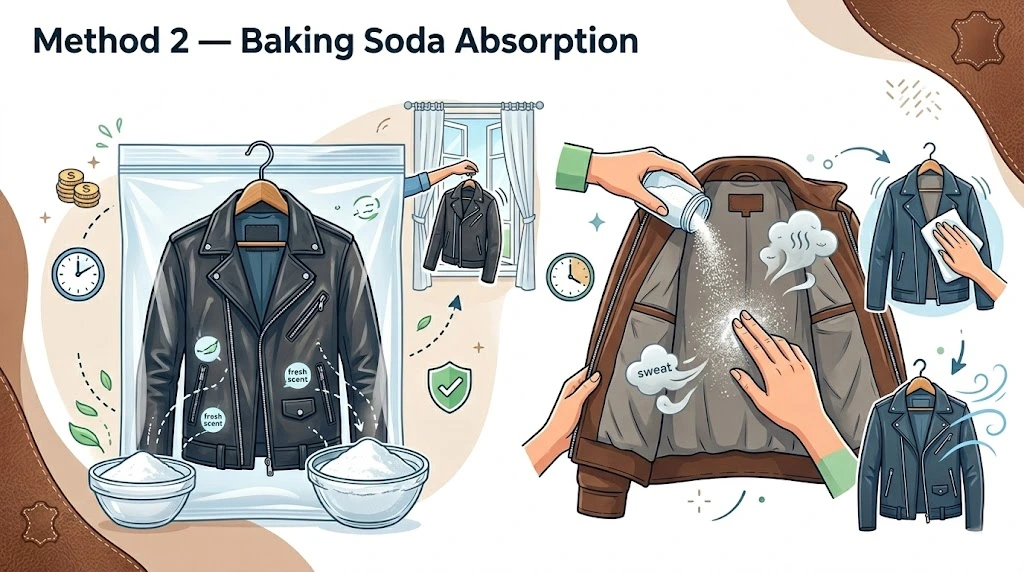
Baking soda is one of the most effective natural odor absorbers available. The key is to never apply it directly onto the leather — it can cause discoloration.
Exterior method:
- Place the jacket inside a large plastic bag or sealed box
- Put an open container or small bowl of baking soda inside the bag — not touching the jacket
- Seal the bag tightly
- Leave for 24 to 48 hours
- Remove, shake out, and air for 30 minutes before wearing
Lining method (for inside smells):
- Turn the jacket fully inside out
- Lightly sprinkle baking soda on the lining fabric only
- Gently rub it in with your fingertips
- Leave for 2 to 3 hours
- Shake out completely and wipe with a dry cloth
- Air out for another hour before wearing
Method 3 — White Vinegar Solution
Cost: Very low | Risk: Low (patch test required) | Best for: Smoke, mildew, sweat
White vinegar is a natural acid that neutralizes odor-causing bacteria. It smells strong at first but the odor disappears as it dries, taking other bad smells with it.
What you need:
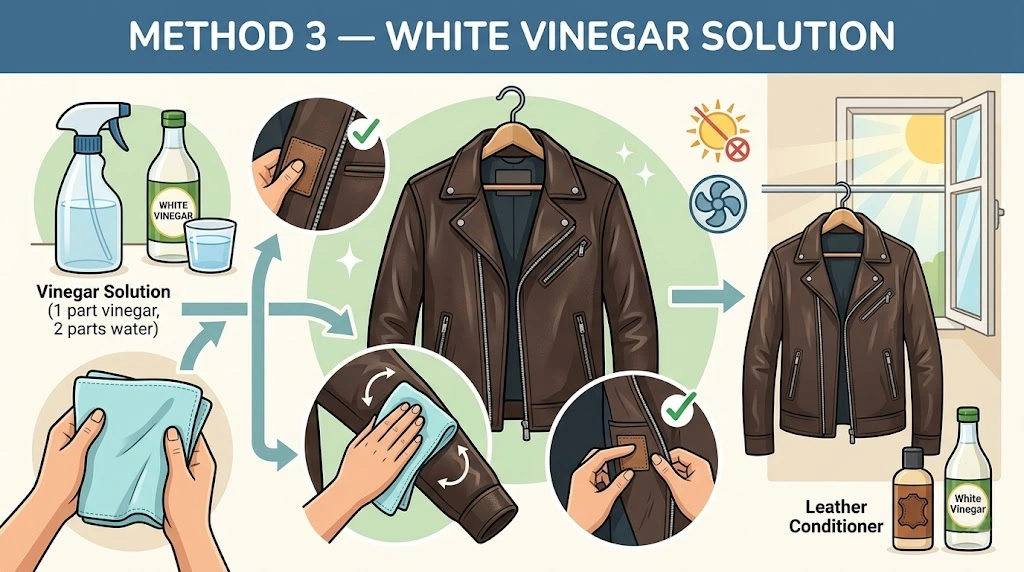
- 1 part white vinegar
- 2 parts water
- Spray bottle
- Soft microfiber cloth
Steps:
- Mix vinegar and water in the spray bottle
- Patch test on a hidden area — wait 10 minutes and check for any color change
- Lightly spray onto the microfiber cloth (never spray directly on the jacket)
- Wipe the jacket exterior in gentle circular motions
- For the lining, dampen a cloth and wipe — do not soak
- Hang to air dry in a ventilated area away from sunlight
- Once fully dry, apply a leather conditioner to restore moisture
Important: Do not use on suede or nubuck. Use only on smooth leather surfaces.
Method 4 — Activated Charcoal
Cost: Low | Risk: None | Best for: Heavy, persistent smells including smoke and mold
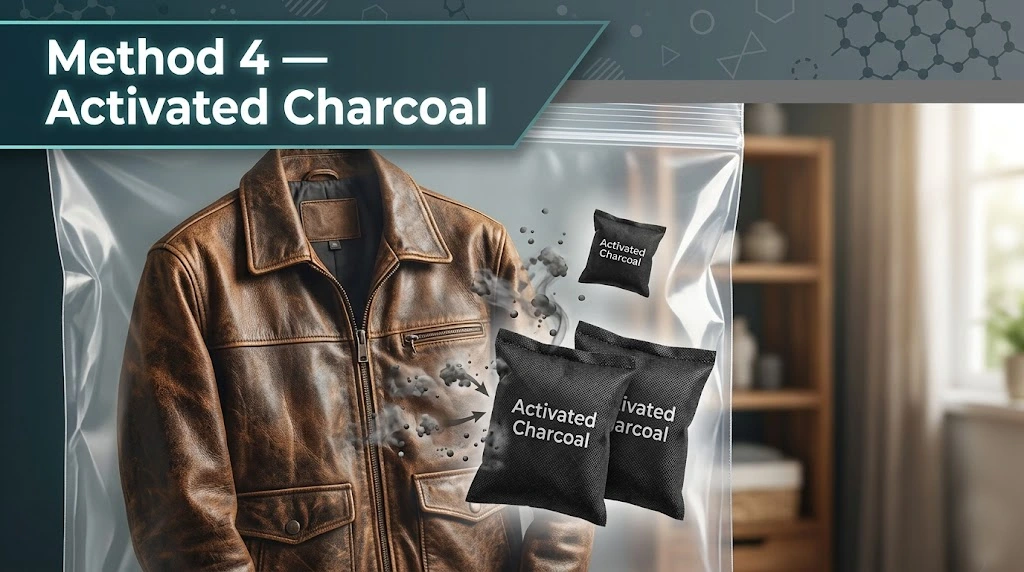
Activated charcoal is more powerful than baking soda for absorbing deep, stubborn smells. It works without any contact with the leather at all.
How to use:
- Place the jacket in a large bag or sealed box
- Put 2 to 3 activated charcoal sachets or bags inside (available at pharmacies and online)
- Seal and leave for 48 to 72 hours
- Remove and air out for 30 minutes
This method is especially effective for smoke smells and jackets that have been in storage for a long time.
Method 5 — Coffee Grounds Trick
Cost: Very low | Risk: None (no contact with leather) | Best for: Chemical new-leather smell, general odors
Ground coffee is a natural odor absorber and leaves a light, pleasant scent behind.
How to use:
- Place dry, used (or unused) coffee grounds in a breathable cloth bag or old sock
- Put the jacket and the coffee bag in a sealed box
- Leave for 24 hours
- Remove, air out, and check — repeat if needed
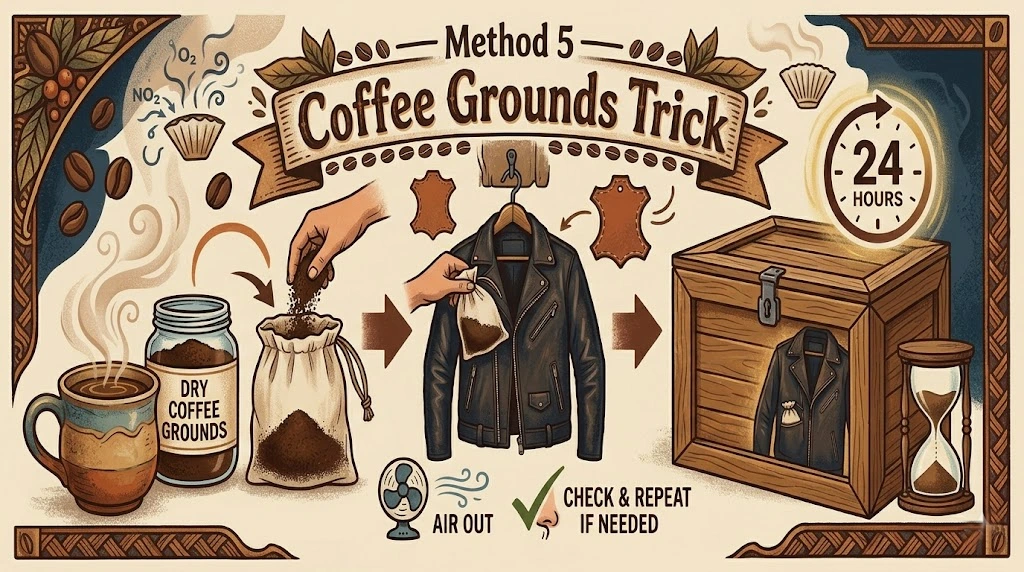
Do not let coffee grounds touch the leather directly as they can stain.
Method 6 — Leather-Safe Deodorizer Spray
Cost: Medium | Risk: Low | Best for: Regular maintenance and quick refresh
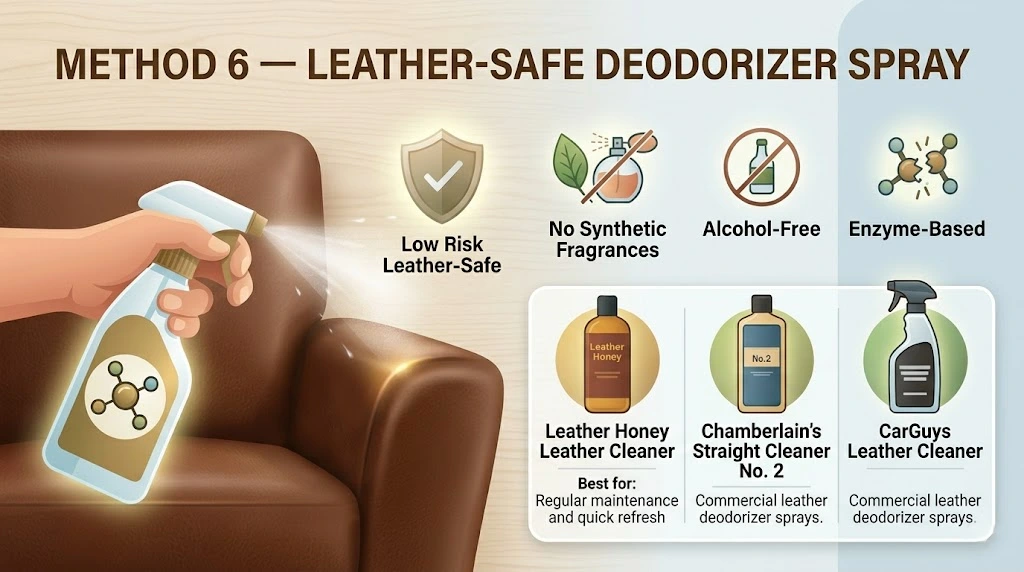
Commercial leather deodorizer sprays are formulated to eliminate odors without stripping the leather’s natural oils.
What to look for:
- Alcohol-free formula
- Specifically labeled safe for leather
- No synthetic fragrance maskers — look for enzyme-based formulas that break down odor molecules
Recommended products:
- Leather Honey Leather Cleaner
- Chamberlain’s Straight Cleaner No. 2
- CarGuys Leather Cleaner
How to use: Spray lightly from 6 inches away, wipe with a soft cloth, and allow to air dry. Always follow with a leather conditioner.
Method 7 — Steam Treatment
Cost: Low (if you own a steamer) | Risk: Medium (keep distance) | Best for: Surface odors, light mildew, freshening up
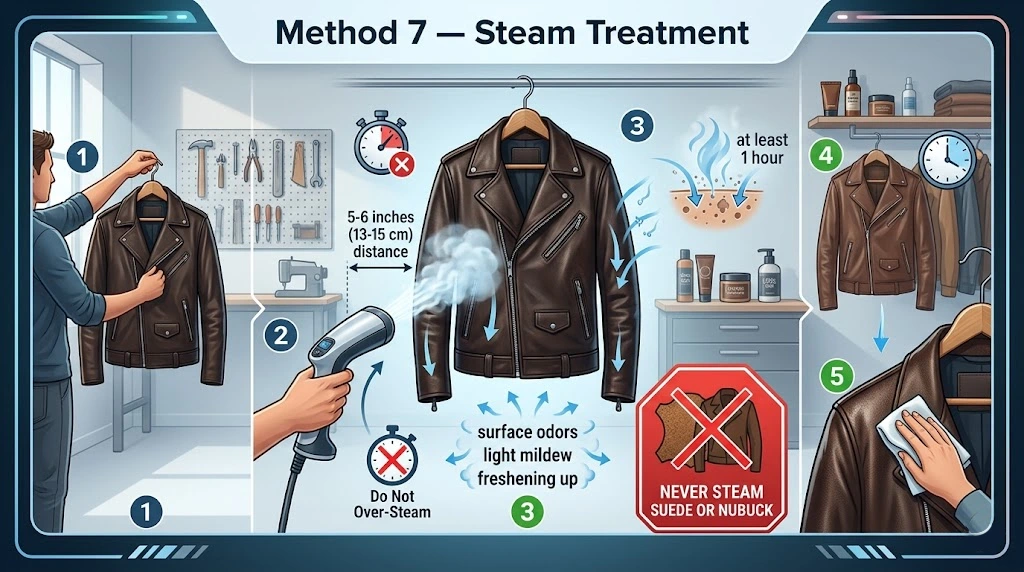
Steam opens leather pores and helps release trapped odors. It also kills surface bacteria and relaxes wrinkles.
Steps:
- Hang the jacket on a hanger
- Hold the steamer 5 to 6 inches away from the surface — never let it touch
- Move in slow, downward strokes
- Do not over-steam any single area
- Never steam suede or nubuck
- Hang to air dry for at least an hour after steaming
- Apply leather conditioner once fully dry
Method 8 — Professional Leather Cleaning
Cost: High | Risk: None (if you choose correctly) | Best for: Severe mold, deep smoke damage, valuable jackets
If home methods haven’t worked after multiple attempts, or if you’re dealing with heavy mold or extremely deep smoke damage, a professional leather cleaner is worth the investment.
Tips for choosing a professional cleaner:
- Make sure they specialize specifically in leather garments — not just general dry cleaning
- Ask if they use ozone treatment, which is highly effective for smoke and mold smells
- Mention the jacket’s leather type and any previous treatments you’ve tried
- Expect to pay more for mixed-material jackets (e.g., wool body + leather sleeves)
How to Treat Specific Smells
Cigarette / Smoke Smell
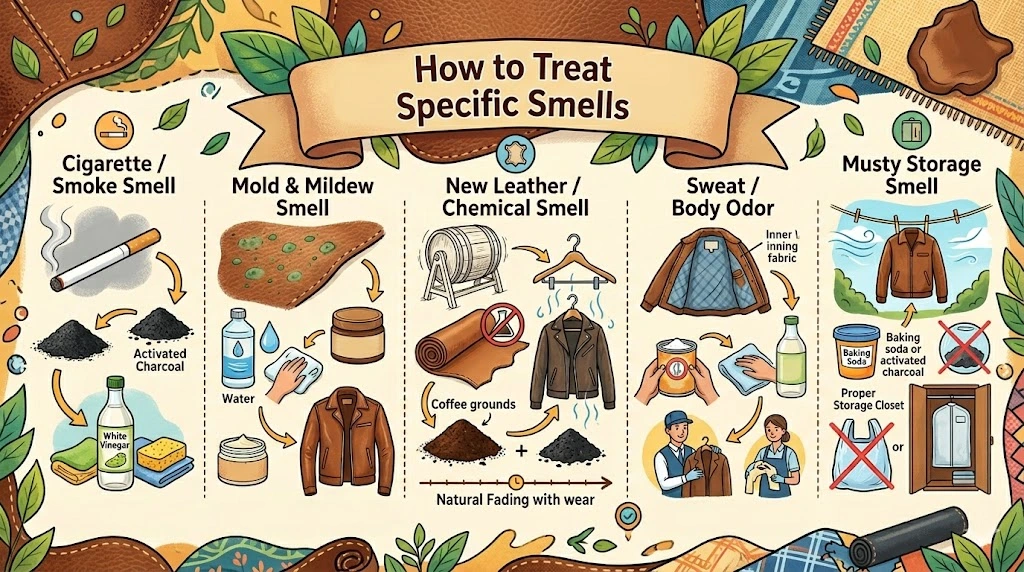
Most stubborn smell to remove. Start with activated charcoal for 72 hours, then follow with the white vinegar method. For very heavy smoke, professional ozone treatment is the most effective solution.
Mold & Mildew Smell
Mix equal parts rubbing alcohol and water (for smooth leather only). Dab — don’t rub — on affected areas with a soft cloth. Allow to dry fully. Follow with a leather conditioner. For widespread mold, go to a professional immediately as mold spreads.
New Leather / Chemical Smell
This comes from tanning chemicals and is completely normal. Air the jacket out for several days. Place activated charcoal or coffee grounds nearby. The smell naturally fades within 1 to 3 weeks of regular wear and airing.
Sweat / Body Odor
Usually trapped in the lining, not the leather. Use the baking soda lining method. Wipe the interior fabric lining with a cloth lightly dampened with diluted white vinegar. For severe cases, have the lining professionally cleaned.
Musty Storage Smell
Air out for 48 hours first. Then use baking soda or activated charcoal method. Store properly going forward — never in plastic.
Mistakes That Make the Smell Worse
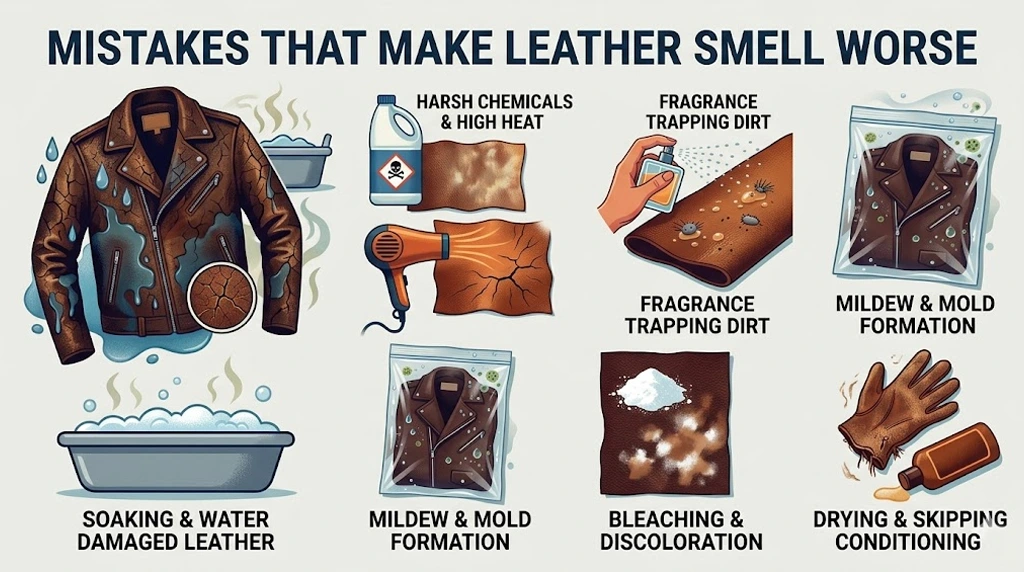
Avoid these common errors that can permanently damage your jacket or lock in the smell:
- Soaking the jacket in water — leather absorbs water and can warp, stiffen, and crack as it dries
- Using bleach or harsh detergents — strips natural oils and ruins the finish
- Drying with a hairdryer or near a heater — causes cracking and shrinkage
- Spraying perfume directly on leather — temporarily masks odor but leaves sticky residue that attracts more dirt and eventually smells worse
- Storing it in a plastic bag — traps moisture and creates mildew
- Applying baking soda directly on leather — can bleach or discolor the surface
- Skipping the conditioner after cleaning — every cleaning method strips some moisture from leather; always condition after
How to Keep Your Jacket Smelling Fresh (Prevention)
Removing smell is hard. Preventing it is easy. Build these habits and you’ll rarely need to deep clean.
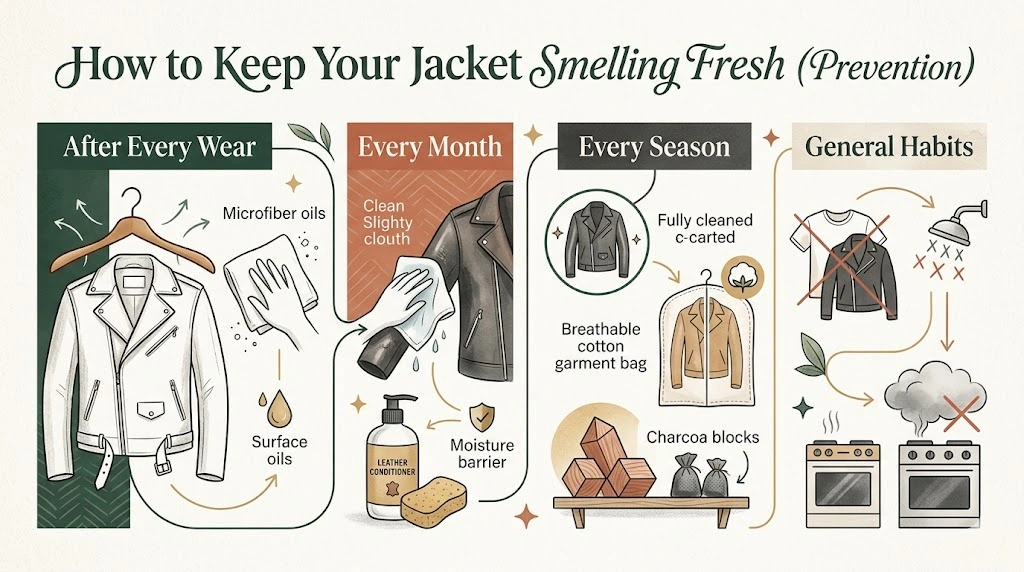
After every wear:
- Hang on a wide hanger in an open space for 30 minutes before putting away
- Wipe the surface lightly with a dry microfiber cloth to remove surface oils
Every month:
- Wipe down with a slightly damp cloth
- Apply a small amount of leather conditioner to maintain the moisture barrier that resists odor absorption
Every season:
- Do a full clean and condition before storing
- Store in a breathable cotton garment bag, never plastic
- Add cedar blocks or activated charcoal sachets in the storage area
- Keep in a cool, dry, dark place away from humidity
General habits:
- Avoid wearing directly over sweaty clothing
- Don’t hang in the bathroom — steam and humidity are leather’s enemies
- Keep away from kitchen cooking smells when possible
Buying Guide — How to Choose a Leather Jacket That Stays Fresh Longer
The best time to prevent odor problems is before you buy. Here’s what to look for:
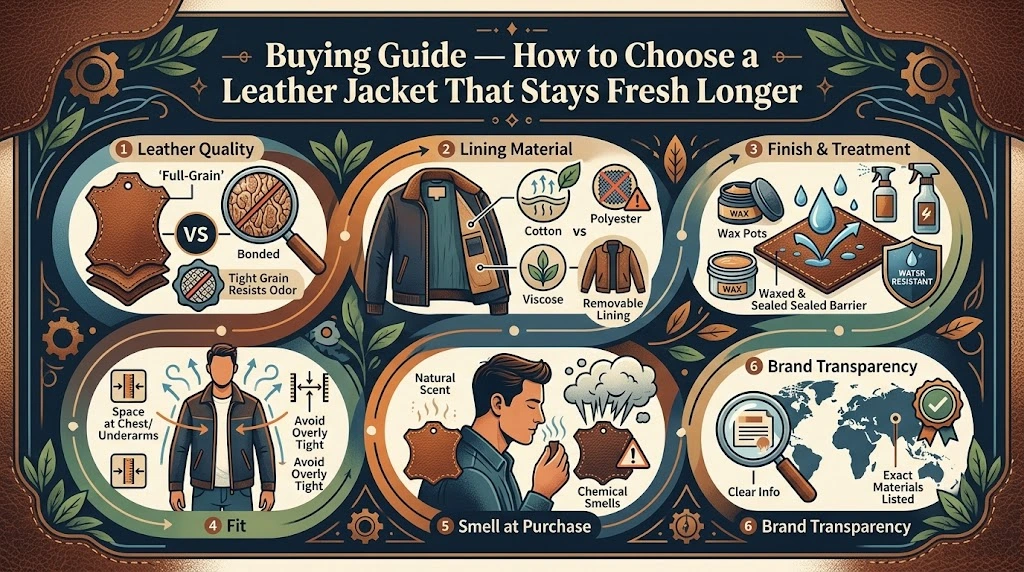
Leather Quality: Full-grain and top-grain leather have tighter, more uniform grain structures that resist moisture and odor absorption better than bonded or genuine leather. Invest in quality leather and you’ll have far fewer smell issues long-term.
Lining Material: The lining is where sweat and body odor accumulate most. Look for jackets with cotton or viscose linings over polyester. Cotton breathes better and is easier to spot clean. A removable or partially unstitched lining is a bonus — it allows the jacket to air out from the inside.
Finish & Treatment: Waxed, treated, or sealed leather finishes create a natural barrier against moisture and odor absorption. Ask the brand whether the leather has been treated for water resistance.
Fit: A well-fitted jacket allows natural airflow around your body. An overly tight jacket traps heat and accelerates sweat absorption. Choose a fit that gives you an inch or two of space at the chest and underarms.
Smell at Purchase: A jacket that smells extremely strong of chemicals in the store has likely been heavily treated or is made from lower-quality leather with harsh tanning agents. A light, natural leather scent is ideal. Very strong chemical smells take longer to fade and sometimes never fully disappear.
Brand Transparency: Choose brands that tell you exactly what type of leather they use, where it’s sourced, and how the jacket is treated. Vague descriptions like “premium leather” or “high-quality material” without specifics are a red flag.
FAQs
How long does it take to remove bad smell from a leather jacket? Light smells from everyday wear usually clear up in 24 to 48 hours of proper ventilation. Moderate smells like musty storage odors take 3 to 5 days using baking soda or activated charcoal. Heavy smells like deep smoke or mold can take multiple treatments over 1 to 2 weeks, or may require professional cleaning.
Can I put my leather jacket in the washing machine to remove the smell? No. Machine washing will warp the leather, crack the surface, destroy the shape, and ruin the finish permanently. Never machine wash any genuine leather jacket.
Does the new leather smell go away on its own? Yes. The chemical smell from new leather fades naturally over time with regular wear and proper ventilation. Airing the jacket out daily and using the activated charcoal method speeds this up. Most new leather smells fully dissipate within 2 to 4 weeks.
Is it safe to use fabric softener on a leather jacket? No. Fabric softeners are designed for textile fibers and are not compatible with leather. They can leave sticky residue, clog leather pores, and cause long-term damage to the surface.
My jacket smells fine on the outside but bad on the inside — what should I do? The lining is holding the odor. Turn the jacket inside out and use the baking soda lining method or lightly wipe the interior fabric with a cloth dampened with diluted white vinegar. For persistent lining odors, a professional cleaner can clean just the lining without affecting the leather exterior.
Can I use essential oils to make my leather jacket smell better? Use with extreme caution. Some essential oils can stain leather. If you want to try it, add 2 to 3 drops of essential oil onto a cotton ball and place it inside the jacket without touching the leather. Never apply oils directly to the leather surface.
How do I know if the smell is mold and what should I do? Mold smells distinctly earthy, damp, and musty — different from sweat or smoke. Look for dark spots or a slightly fuzzy texture on the leather. If you see or strongly suspect mold, treat it immediately with a diluted alcohol solution and consider professional cleaning, as mold spreads and can cause permanent leather damage.
Will dry cleaning remove the smell completely? A reputable leather specialist dry cleaner will significantly reduce or eliminate most smells. For extreme cases like heavy smoke, ask specifically about ozone treatment, which is the most thorough odor-removal method available.